Seeing Familiar Places and New Ones on Connecticut Open House Day

Indoors or outside, the weather was great this past Saturday, June 8 for Connecticut residents to check out our state’s annual Open House Day. With more than 100 attractions statewide participating, I decided to stick around Fairfield County to get reacquainted with two museums that I last saw as a child. Plus, one has a new neighbor that is worth climbing around.

Fphoto-24irst, I headed out to The Discovery Museum and Planetarium on Bridgeport’s Park Avenue, near the city’s border with Fairfield. A mainstay since I can remember, the three-level museum pays tribute to milestones in science, innovation, and exploration. On the main level, the museum’s “Adventure Science” section starts with a jungle gym set up that provides a miniature version of the Adventure Park located next door. Younger visitors didn’t hesitant to try it out, climbing, jumping and running around the structure.

Moving on across the wing, the next space shows how Bridgeport and other places in Connecticut made major strides in engineering such as Sikorsky Aircraft in Stratford, whose founder Igor Sikorsky is credited with launching the U.S. helicopter.photo-28 With space exploration, Hamilton Sunstrand Space Systems in Windsor Locks (now known as UTC Aerospace Systems) developed a portable life support system for NASA space suits worn by Buzz Aldrin and Neil Armstrong for the 1969 moonwalk.

Speaking of outer space, the lower level holds the museum’s Planetarium and a Challenger Learning Center, along with AV displays about the planets and enlarged photos of the  cosmos. Here youngsters can also go exploring with MoonBase Discovery, a section with shuttles for climbing inside and getting behind the wheel. Don’t forget to head up to the third floor for more hands-on activity with a mixture of exhibits highlighting energy in all its various forms.

photo-33Going back outside, my next stop was at The Adventure Park at The Discovery Museum, which is behind the museum’s property. Opened two years ago, the aerial attraction sits on five acres of woods in Veterans Memorial Park, with 11 different course levels that encourage you to climb, crawl, pull through and step across one platform to the next and reach the end point by zip lining.

Choose to stick in your comfort zone, starting with a new purple line, or perhaps challenge yourself to reach a level like the double black diamond (60 feet up). Go at your own place. Other things help put fears aside. The park’s crew members suit you up in a fitted harness and gloves and give clear instructions about the magnetic clips you’re given to get to each point.

And you’re not left hanging mid-course. Call for help by saying “staff,” which I did, and they will come. I finished with a needed upper body workout and a confidence boost.

Finishing out the day, I drove up to Stamford for a quick jaunt around the Stamford Museum & Nature Center, which is close to the Merrittphoto-43 Parkway. The 118-acre property has a nice mix of family activities: hiking trails, a working farm, a children’s playground, nature center, a nature preserve, and an observatory. Heckscher Farm is home to goats, sheep, pigs and chickens, with an organic vegetable garden and an animal embassy. Step inside Bendel Mansion and Museum Galleries to see the former summer home of New York designer and department store owner Henri Willis Bendel.

Even if Connecticut Open House Day is now closed, get out and see these places!

Umbria Tourism Goes Tech with MultiMedia App Launch

photo-22Known as the “green heart of Italy,” Umbria is symbolized by food, wine, ceramics, history and culture. It’s also quite picturesque, as this central and landlocked region is noted for its scenic character with rolling green hills and historical towns like Assisi.
To better market its visual appeal, Umbria’s tourism board has taken a tech savvy approach that connects old-world traditions with modern-day applications. At a June 3 reception at Eataly in New York City, representatives unveiled English versions of UmbriaApp, a collection of roughly 20 apps using a multimedia storytelling approach to showcase the region’s offerings.

During the reception, officials described the process of creating the UmbriaApp line as a  “imaginary bridge” between Umbria’s past and future innovation, in terms of shaping the direction in which tourism hopes to go.

photo-21As of this writing, the English apps will be released first for iPad, with versions for iPhone and Android to follow shortly. Italian versions are currently available. Developed by Sesinet Snc, an Italian company, all apps are free and can be downloaded through iTunes.

Varying by subject, apps cover art and history museums, festivals, bike tours and particularly food and wine.

One of the new apps that is quite appetizing is “Umbria Enogastronomia.” This culinary app is a virtual cookbook on Umbria’s authentic wines and cuisine, covering the region’s meats, cheeses, fruits and vegetables. Users can also replicate a taste of this region in their kitchen by browsing through the app’s range of recipes, complete with photos, ingredients, and preparation notes.

The unveiling at Eataly kicked off “Umbria Week 2013,” a week-long roster of activities in Manhattan from June 3 through June 8 that serves as a precursor to a “Sensational Umbria,” a month-long celebration scheduled for November.

In highlighting Umbrian cuisine, samplings of traditional dishes such as lentil soup (with its recipe included in the culinary app) and pesce crudo were offered. Tastings provided by Goretti Winery in Perugia, Umbria’s capital, complimented the evening.

Visit New and Familiar Places During Connecticut’s Open House Day June 8

If you’ve grown up in Connecticut, it’s most likely that you visited the state’s major attractions through family outings. You went to landmarks and museums for a homework assignment or with your classmates on a field trip. Even more so, you probably explored a state park, nature preserve or family-owned farm.

Yet there are still many hidden gems throughout its regions that deserve a second look.

OpenHouse150_lg_130131118233619201Each year, the CT Office of Tourism organizes Connecticut’s Open House Day, a marketing promotion that encourages CT residents to stop by or spend more time at the diverse public offerings across the state. This year, the open house falls on Saturday, June 8.

As of this writing, 188 locations are providing free or discounted admission, gifts or special activities. From Coastal Fairfield County up through River Valley, long-time favorites and local names are scheduling tours or sample tastings, offering giveaways or unveiling new exhibits.

With attractions suitable for many ages and personal interests, here are some spots worth a visit (or revisit):

Connecticut’s Beardsley Zoo: From 9 a.m. to 4 p.m., admission will be free for the first 100 visitors. Bridgeport, (203) 394-6565.

Spa at Norwich Inn: From 7 a.m. until 8 p.m., the Spa is offering a 15 percent discount on day spa treatments and dining. Also, free tours of the historic property are scheduled. Norwich, (860) 886-2401.

Westford Hill Distillers: From 10 a.m. to 4 p.m., this distillery, which is not generally open to the public, will offer free, guided tours. Ashford, (860) 429-0464.

Lime Rock Park: Open from 9 a.m. until 5:30 p.m., each visitor get a free hot dog and Coca-Cola drink. Come in the morning to watch Lime Rock Drivers Club travel over the tracks and the afternoon, the Eastern Motor Racing Association. Lakeville, (860) 435-5000.

The Glass House: Visitors will receive a complimentary hard cover coffee table book, “Modern Views,” and can explore the interior of this iconic house and its 47-acre landscape. The two-hour tours leave at 9:45 a.m., 10:30 a.m., 11:15 a.m., noon, and 1:30 p.m. Advance reservations are required. New Canaan, (203) 594-9884.

To get a full list of participants in Connecticut’s Open House, visit http://www.ctvisit.com/dontmiss/details/1256. As for me, I’m going to hit up the Discovery Museum in Bridgeport and Stamford Museum & Nature Center.

From Coastal Farming to Current Wineries: Exploring Stonington, CT

photo-16 Whether driving by via I-95 or following the northeastern part of Connecticut’s Wine Trail, Stonington is worth making a car stop. This town still reflects its agrarian days with lush green fields and colonial era houses lined with stonewalls, with its founding dating back to the mid-1600s as a trading post. With two lighthouses, Stonington encompasses a number of villages including Pawcatuck, Stonington Borough, Lords Point, Wequetequock, and the eastern halves of Mystic and Old Mystic.

Speaking of Connecticut’s Wine Trail, a few wineries are found in Stonington. With the right timing and planning, it’s possible to visit them all in a single day. Last Sunday, I trekked up to join an afternoon group meeting at just one of them: Saltwater Farm Vineyard.

photo-9Like its name, Saltwater Farm Vineyard has both unique surroundings and just as interesting back story. Upon arriving at its location, it’s understandable to think at first whether or not you’re at the right place or if your GPS led you astray. It’s fine and appropriately fitting. The 100-plus acre vineyard borders the tidal marshes of Wequetequock Cove, a saltwater field that provides a nice backdrop setting against an inlet.

The exterior also has a link to Stonington’s past, as a portion once used as farm land until the early 20th century. Here’s also where the winery’s story gets neater. In the late 1930s, a small commuter airport opened on the grounds, with a hangar built there, and had operated until the U.S. entered World War II.

After the war ended, the airport became a flight school for a few years. Over time, the hanger turned into a restaurant, a warehouse, and a manufacturing facility, and then eventually became abandoned.

Its new life as a winery came in 2001, when the property was bought by a lawyer and converted. The former photo-8aluminum-sided hanger now houses an open-air tasting room/reception hall with large stainless steel tanks on the ground floor and a second level for bar service with a walkout terrace for overheard views of the vines and surrounding marshland. Here you can also picture what the sight was previously: the airfield.

Though its airport days are long gone, the venue still has a grassy landing strip. A server told me that it still is used on occasion. Perhaps for guests flying in?

photo-13The winery also hosts live music performances on Sundays with a vendor providing fresh-shucked oysters. During my time, tasting notes included a Manager’s Choice, with the selection of the day being a Rose; a 2011 Chardonnay aged in the steel tanks; a 2008 Merlot; and a 2010 Cabernet Franc/Merlot Blend. The later two wines are aged in French oak barrels. Also note: glasses are sold separately.

While in Stonington, definitely visit nearby wineries such as Stonington Vineyards, about 10 or 15 minutes from Salt Farms, and Jonathan Edwards Winery, which is in North Stonington and about a 20- to 30-minute ride.

Delta’s NYC ‘Pop-up’ Lounge In Flight Until May 22

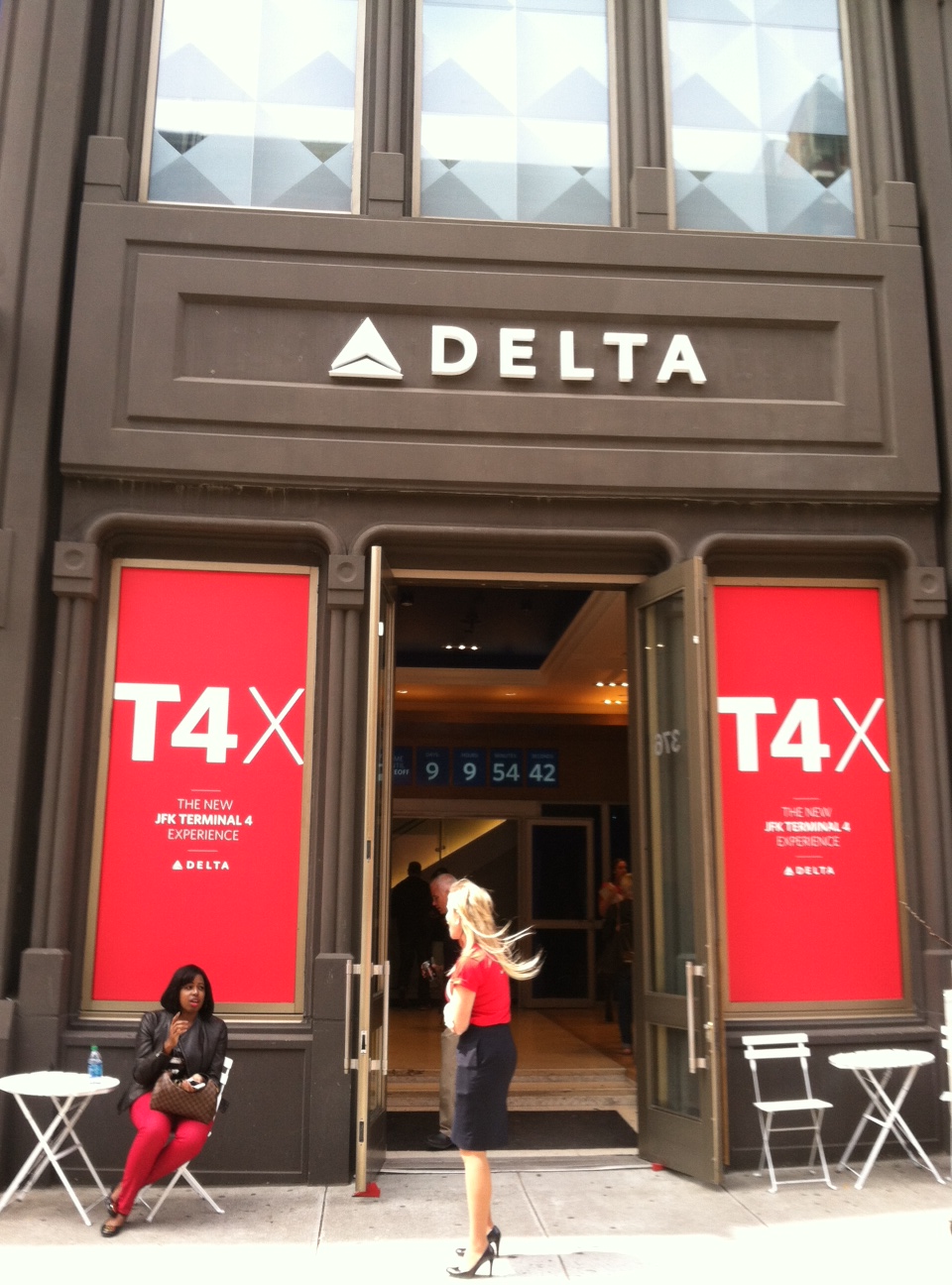
In celebrating the upcoming opening of its JFK Terminal 4, Delta invites the public to visit T4X, a pop-up lounge in Soho until May 22.

In celebrating the upcoming JFK Terminal 4, Delta invites the public to visit T4X, a pop-up lounge in Soho until May 22.

With airports, the average person’s experience consists of the rig moral of check-ins, security lines, and gate departures. Delta is doing a neat thing in giving the general public the chance to see what lounging is like.

Until next Wednesday, visitors can stop by T4X, a “pop-up” space in New York City’s Soho district. And, just hang out.

Since May 1, Delta has been hosting this experimental setting in a three-story building, at West Broadway and Broome Street, to celebrate and promote another recreation that’s more permanent. The major carrier’s newly transformed Terminal 4 at JFK will open on May 24, complimented with a 24,000-square-foot SkyClub and a SkyDeck!

T4X, or in using its full name Delta T4 Xperience, gives off a sneak peek. Upon entering, Delta representatives take you to show you neat offerings and goodies to choose from. For example, you can pick a travel-related knickknack (a passport holder, mirror, cold drink cup or luggage tag) from a vending machine.

At T4X, order a boxed lunch inspired by an international destination.

At T4X, order a boxed lunch inspired by an international destination.

Visitors can register for a chance at winning giveaways like a set of beauty products. A kiosk allows for Delta passengers to check on or adjust itineraries on spot. There’s even a countdown clock anticipating Terminal 4’s debut. (I’ll be seeing it firsthand this summer, with my flight to Reykjavík.)

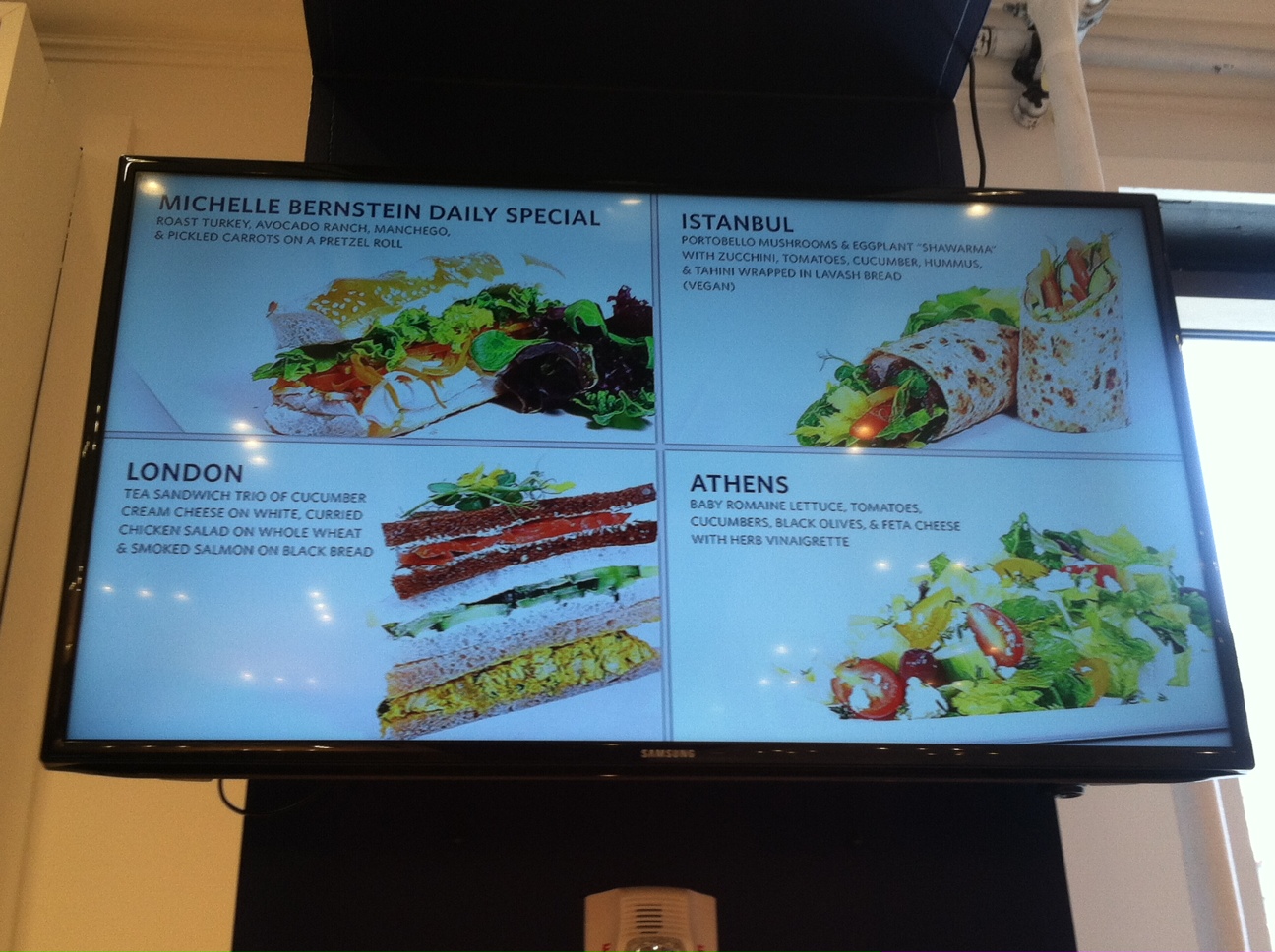
As meals and airlines go hand in hand, T4X provides four daily lunch selections that go beyond traditional serving options.

photo-5

Lunch in a little suitcase!

With the new Terminal 4 centering on only international flights, T4X’s daily changing menu reflects top world destinations. Edible options inspired by London, Rome, Mexico City, Athens and Istanbul feature sandwiches or salads with flight treats such as cookies, pretzels, fruit and a choice of water or soda. Decide on your meal by viewing a flight information screen listing the day’s choices.

Grabbing lunch has a baggage claim approach as a conveyor belt setup has suitcase-looking boxes circling around. Each lunch is priced at $4; credit card payments only.

photo

Outlets and plush setting enable visitors to recharge their batteries, physically and electronically.

Head upstairs and hang out in T4X's lounge section.

Head upstairs and hang out in T4X’s lounge section.

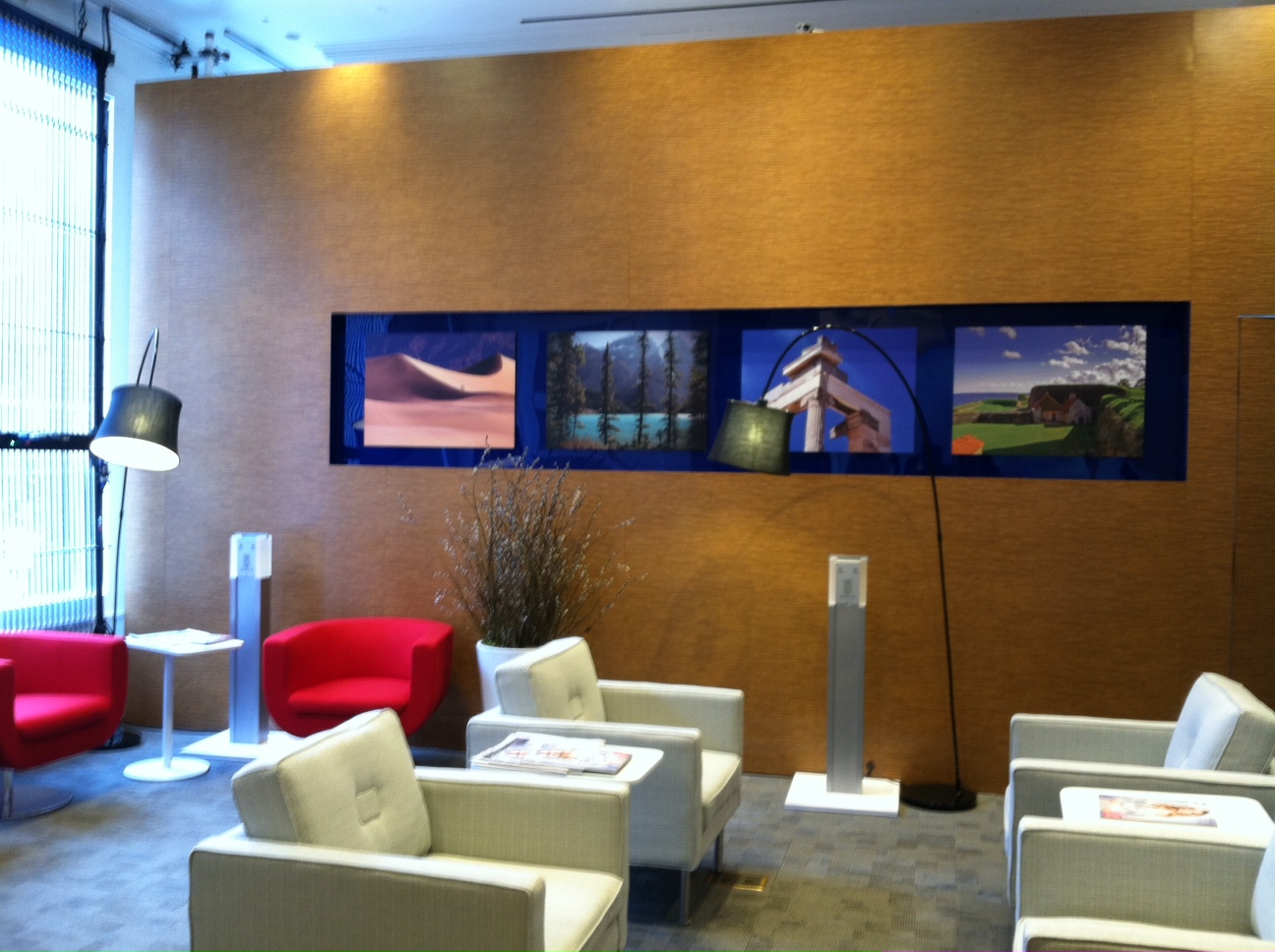
Go upstairs to the second level, and here is where to find the lounge. In one area, there is café-style table seating. Across from this section, a more of a sit-down room has plush chairs and tables with nearby outlets for charging up laptops and smart phones. Free Wi-Fi is also provided.

True, T4X is a cool marketing setup. Yet it’s a little treat for those who don’t fly continuously or never had access to an airport lounge before, or perhaps whose travel budgets really have been tightened up. Or, maybe they just work in SoHo and are heading out for their lunch break.

T4X is open from 11 a.m. to 3 p.m. Tuesdays through Sundays until May 22. For maps, the street address is 376 West Broadway. Check it out!

Wine and Yoga in Washington Crossing, PA

DSCN0110

Washington Crossing is a historic town in Pennsylvania.

Day trips are fun and recently I went on a Saturday afternoon outing to Washington Crossing, Pennsylvania (a new place to visit) whose itinerary merged together two of my (long-time) likes: wine and yoga.

Heading to the Hells Kitchen neighborhood of Manhattan – and a last minute shopping dash to and from a sporting goods store upon realizing I left my yoga mat at home – I boarded a bus with about 35 others for a day of stretching and sipping.

Roughly about a two-hour ride from New York City, our group reached Washington Crossing, a small village in Pennsylvania’s Bucks County. It’s a rural and quaint town with significance in U.S. history.

For our first stop, we arrived at Washington Crossing Historic Park in Upper Makefield Township for an outdoor yoga session. The park is a lovely outdoor venue, based on the banks of the Delaware River. There are opportunities for strolling, jogging, and yes, even yoga by the water.

Washington Crossing Historic Park has an important link to the American Revolutionary War.

Washington Crossing Historic Park has an important link to the American Revolutionary War.

Though my group’s time there just lasted an hour, I got to learn a bit more about this park. As you may have guessed, the park gets its name and fame as the site where General George Washington crossed the river around Christmas 1776 during the American Revolutionary War. He and his troop surprised Hessian troops stationed in what is now called Trenton, N.J.

On the U.S. National Register of Historic Places, the park contains a number of buildings that give glimpses into Washington Crossing’s past: 18th and 19th-century homes, a former general store/post office (used when the town was known by its previous name, Taylorsville), and a replica of a boathouse used by Washington and his men. Also, find there an inn/tavern run during Washington’s time. Of course, our future first president ate and planned his military strategy there.

DSCN0116

Crossing Vineyards and Winery, located on a 200-year-old estate, produces a number of whites, red and specialty wines.

Moving onward, the day’s part two led us to lengthen our taste buds at a winery less than a mile away.

Crossing Vineyards and Winery is located on a 200-year-old estate, where the current vintner grew up as a child, and operates on modern sustainable practices and with state of the art technology. For example, a computerized weather station records data on rainfall, temperature, dates of frost, and hours of sunshine to help with determining grapes that will grow best in the microclimate. Laser planting has been used in planting 10 acres of Vinifera winegrapes to help budding vines get a better and safer growth start. Today, grape varieties grown here include Chardonnay, Cabernet Sauvignon, Cabernet Franc, Vidal Blanc and Chambourcin.

With its focus on handcrafting subtle yet refined wines, Crossing Vineyards and Winery produces a variety of whites and reds as well as specialties including Sangria and Chocolate Cherry Truffle, a Port-style dessert wine. My group enjoyed a late afternoon tasting with 10 wines paired with various cheeses and chocolate. Samplings including Chardonnay, Cabernet Franc, Viognier, Merlot and Sangria. A fan of Sangria and flavors of chocolate and cherry, I purchased two bottles to take home. Definitely make a day trip to Washington Crossing!

Exploring Vienna through Sights, Sounds and Tastes

For me, Vienna is magical. Please don’t mind that I use this cliche, but this Austrian capital brings visitors back in time. Baroque castles and gardens lining the Ringstrasse are strong reminders of the city’s royal past, as the central point of the Austro-Hungarian Empire. And a musical legacy inspired by Mozart, Brahms and other composers can still be heard today. During my visit last July, I explored Viennese attractions that I could see, taste and even listen to.
Learn about Royal Living 

Austria was once ruled by a dual monarchy, which lasted from 1867 until the end of World War I in 1918. Two grand palaces that housed many rulers belonging to the Habsburg dynasty still stand, and are worth visiting.

The Hofburg has housed members of the power Habsburg dynasty.

The Hofburg has housed members of the powerful Habsburg dynasty.

At the Hofburg, a winter residence, get a glimpse into the Imperial Family’s daily royal living. The Imperial Apartments were home to Emperor Franz Joseph and his wife, Empress Elisabeth, their children and the entire royal household.

The Sisi Museum focuses on the life of the beautiful Empress Elisabeth, also known as “Sisi.” Her story is unique. She was big on beauty and fitness. A free spirit, she apparently shied away from decorum. Her life ended tragically with her 1898 assassination in Geneva. Artifacts range from dresses to portraits, and jewelry.

On the grounds of the Hofburg, horse lovers will enjoy the Spanish Riding School, where they can view Lipizzans, a special breed that is trained to perform haute école, a classic style of equestrian skills. Guided tours include visits to their stables. I got to catch glimpses of these lovely horses when they came out to graze for their afternoon lunch.
During the summer months, the Habsburgs ventured from the city center to Schönnbrunn Palace, an elaborate 1,441-room getaway. First built as a hunting lodge, this UNESCO World Cultural Heritage Site was transformed into a marvel of Baroque architecture during the reign of Maria Theresa, the mother of Marie Antoinette. Its landscape is graced with formal gardens, sculptures, a zoo and a labyrinth. If you plan to visit, it’s best to get here in the morning before the crowds arrive.

Concerts and Composers

Catch a performance inside the opera house, Staatsoper.

Catch a performance inside the legendary opera house, Staatsoper.

In Vienna, music plays on. A great way to experience its culture is by attending a performance in a concert hall or opera house. The 200-year-old Musikverein is a concert hall known for having great acoustics and is the residence for the Vienna Philharmonic orchestra. Works by legendary classical composers from Brahms to Tchaikovsky were introduced here. About 800 concerts take place annually.

If like me, you’ve never had a night at the opera, consider buying tickets to a concert at Staatsoper, Vienna’s opera house which dates back to the 19th century. I attended a performance here, and had a great time. Dress up too!

Among composers, Mozart carries quite a reputation here. Out of his 14 addresses throughout the city, Mozarthaus Vienna is Mozart’s only surviving residence. Though he lived at this place for only three years, the composer seemed to have had a lot of ambition. One of them he penned was his opera, The Marriage of Figaro.

Satisfying Coffee and Sweets

Coffee drinkers and dessert lovers can indulge at Vienna’s legendary coffeehouses. It’s a fun, culinary activity.

Enjoy cake, coffee and streudel inside one of Vienna's coffeehouses such as Cafe Sacher.

Enjoy cake, coffee and struedel inside one of Vienna’s coffeehouses such as Cafe Sacher.

A piece of cultural heritage, Viennese coffeehouses date as far back as the late 1600s. Legend says when Turkish forces retreated from a surge in Vienna, they left behind bags of coffee beans. Fact or fiction, their start is associated to Jerzy Franciszek Kulczycki, a soldier who is said to have opened the first coffeehouse.

Best in the sense of the traditional style, Café Sperl has a plush setting. I enjoyed sitting at a marble table, with the waitress bringing over not just a menu but the day’s newspaper for me to glimpse through while enjoying my meal. The coffeehouse is also featured in the film “Before Sunrise.”

My cake cravings led me to check out another venue. Inside the Sacher Hotel, Café Sacher’s claim to fame is Sache Torte, a famous Austrian chocolate cake with an apricot jam filling invented here. Its recipe remains a well-kept secret, yet the cake is labeled with a trademark: a chocolate logo. The café’s red walls and cushioning made this café a relaxing place.

Can’t resist chocolate. Another good stop is at the legendary Demel, a confectionery that once provided sweets for the Imperial family. And to top off food finds in Vienna, go the popular Naschmarkt, an open-air marketplace with shops and food stands touting fruits, nuts, and spices from around the globe. Enjoy!

New York Travel Festival Breaks Consumer Show Mold

DSCN0040

Bohemian National Hall was the venue for Saturday’s portion of the New York Travel Festival.

I got involved in helping with the promotions for the New York Travel Festival, and I’m glad I did. The inaugural event, held last weekend (April 20 and 21), ushered in travel experts and explorers from New York City and beyond.

Produced by RW Social, this new festival was to redesign the concept of the consumer travel show with an innovative program. Focusing on tech-savvy travelers already seeing the world, the event catered to them by inviting travel media’s elite to share insights and perspectives on why we travel, and how we should.

Attendees came out for the festival’s first day at the Bohemian National Hall on the Upper East Side. Andrew Evans, National Geographic’s Digital Nomad, began the morning with his keynote, “Why Your Bucket List Sucks & I’m Gonna Tell You Why.”

Evans isn’t fond of the idea of bucket lists because they sound as though “we’re setting specific travel goals” and not leaving ourselves open to other potential opportunities.

“If we only travel on our bucket lists, we will never get out of our comfort zone,” he said.

andrew

Andrew Evans, National Geographic’s “Digital Nomad,” talks to a show attendee.

Evans had a similar scenario happen after having to stay in Tennessee when the plane he was on had an emergency landing. The next day, Evans decided to go see Graceland, a place he admitted he never wanted to see at first. After spending a few hours there, and seeing Elvis’ personal items like clothes and learning more about him, Evans said he “gained this deep appreciation for who Elvis was, and I started liking Elvis.”

Evans also changed up his talk to reflect on the recent tragedy in Boston, which fit in understandably, and how travel has been impacted by terror in many ways such as with TSA policies that bewilder us all.

Breakout sessions on niche travel along with local/regional topics highlight specific scenarios for women, families, LGBT, and those seeking other alternatives. Here are some highlights:

–  A great talk on women’s travel, led by Go! Girl Guides Founder Kelly Lewis and Christine Maxfield, a former editor at Budget Travel magazine. The ladies offered common-sense safety measures all girls can take. Here’s one: buy a doorstop to securely lock your hotel door in place.

DSCN0071

From left, Rainer Jenss, Charu Suri and Carol Cain share their advice and experiences on traveling with children.

– Yes, it’s possible to successfully navigate family travel. A session on this topic offered solid proof from speakers that were parents of children ranging in age from months old to teens. They were: Carol Cain, travel writer and blogger of GirlGoneTravel.com; Charu Suri of Butterfly Diary; and Rainer Jenss, founder of Smart Family Travel, Inc. and a 13-year veteran of National Geographic.

– Lee Abbamonte, the youngest American to have visited every country, was a contestant in a travel trivia “show,” and got stumped a bit by the audience. He was a good sport.

– Jason Cochrane, now the soon-to-be the editor of Frommers.com, warned his audience about current travel scams such someone “spilling” mustard on you and shared important tips on how to dodge them.

DSCN0047

AnneLise Sorensen throws travel questions at Lee Abbamonte, and takes some from the audience.

It was also nice to see and listen to bloggers and experts whom I’ve met virtually, through social media, in person. Plus, as travel circles go, I got to catch up with friends and meet fellow writers that I already followed via Twitter or through Facebook Groups.

With a visit to the Mexico tourism area, I enjoyed samplings of authentic dishes provided by the restaurants, El Mitote and Café Frida. Translated as “drowned sandwiches,” tortas ahogadas are a Guadalajara favorite, in which a sandwich is submerged in a sauce made of a dried chili pepper or tomato sauce. Mini tortas and ceviche tostadas were also on the tasting menu.

Beverages were included, with agua fresca (watermelon water) and tastings of several kinds of Mezcal, a liquor made from the heart of the maguey plant, the piña. La comida Mexicana es deliciosa!

DSCN0024

Guests savored flavors from Mexico and New York’s Hudson Valley Saturday afternoon.

With New York State, a “Taste of the Hudson Valley” showcased the culinary and cultural offerings in this attractive region.  Taking up one of the show floors, the area hosted a restaurant grouping of The Artist’s Plate, Madava Farms, Gigi Hudson Valley, and Zitoune. Dishes of pasta, cheese and duck highlighted regional fare. Wine and spirits samplings from Millbrook Vineyards & Winery and soon-to-open Dutch’s Spirits were also offered. And on the first floor, a range of New York beers from Shmaltz Brewing were available to sip.

Sunday’s schedule focused on food with guided tours around NYC’s five boroughs. In all, the inaugural New York Travel Festival was off to a good start. See you next year!

On Foot: A Walking Guide through Prague

Last month, I headed to Eastern Europe, with J, my cousin and co-traveler to many places in Europe. For our 2012 meetup, we decided on a 10-day jaunt to Prague, Vienna and Krakow. It was nice to see Eastern Europe, a contrast to the glitz of its Western counterpart.

Each city maintains visual reminders of multifaceted histories: beginning with a royalty-led past up through two World Wars and followed by post-Communist era. Each city has its unique tale. First, I’ll start with Prague.

Like many European cities, Prague is best explored on foot. Much of this Czech city’s center has been declared as a UNESCO World Heritage site and many buildings from the 13th through 18th centuries preserve Prague’s rich legacy. Before you come here, get your best pair of comfortable shoes ready (think flat) and read up on this guide to walking around areas worth seeing.

Old Town (Staré Město)

Don’t worry if you happen to get lost while wandering around Old Town (we almost did). Old Town has winding alleys and cobblestone streets, and one landmark that lets you know you’re in the right place is the Old Town Powder Tower. Built as one of the walled city’s major gateways, the Powder Tower (once used to store gun powder) also marks the way the beginning of the ceremonial route that soon-to-be Bohemian kings would venture down their way toward Prague Castle.

Relax. Your path will eventually lead to Old Town Square, a colorful center location buzzing with shops, restaurants, cafes, and landmarks during the day and evening. The square’s key attraction is the Astronomical Clock gracing the Old Town Hall. On the top of each approaching hour, from 8 a.m. to 8 p.m., crowds gather in front of the 400-year-old clock to watch as two doors open to unveil a procession of rotating figurines.

If you would like to have a less-crowded look at the square, go up inside the building’s tower to reach the top for panoramic views of the city. There are two choices for going up: by elevator or stairs. With the latter, make sure you’re prepared for serious steep climbing. Purchase tickets for entry. Near the National Theater, find the Národní Memorial, a bronze plague graced with hands in a peace sign. It’s located on Národní Street No 16, marking the place where riot police beat college students holding a peaceful protest on a cold night in November 17, 1989.

Charles Bridge
Leaving Old Town, you MUST take a stroll along Prague’s famous landmark: Charles Bridge. Like-minded travelers will stop for picturing taking and posing, and people watching, near the about 40 statues gracing this 650-year-old promenade along the Vltava River. These statues represent various Catholic saints and martyrs placed here as a way to convert locals to Christianity.

Walk alongside fellow tourists, vendors and street performers and artists here. If you happen to notice various colored locks fastened to the bridge’s rails or even on statues, you’re seeing love notes.

Couples who want to symbolize their love will jointly place a lock upon this bridge, then throwing the key into the water. You may spot locks on other bridges around the city as well.
Charles Bridge does get crowded during the day, but you can get a different perspective at night. The other end of Charles Bridge leads you to Mala Strana (Lesser Town), a Baroque section of Prague originally settled by German merchants.

Malá Strana (Lesser Town)
Malá Strana has been a home for diplomats, merchants and those who served at Prague Castle. Red roof houses and prominent churches are found here. Serious shoppers can journey up Nerudova, a steep alley lined with stores from Lesser Town Square up to Prague Castle. For another look at lavish living, go by Wallenstein Palace, built by a duke in the mid-1600s. It’s now being used by the Czech Senate.

Situated in Kampa Neighborhood, John Lennon Wall, also known as Lennon Wall, is a colorful permanent fixture since the 1980s. This space has been decorated with peace-minded graffiti inspired by John Lennon and lyrics from Beatles songs.

Around 1988, the wall became a source of contention for the then-Communist regime. Students would write on their grievances over, and have clashes with, political leaders of that era.

When authorities would order for the wall to be repainted, it would almost shortly be graced with poems and pictures shortly after. The story goes neighboring French embassy asked officials to leave the wall alone, and this request still has been respected.

Hradčany (Castle District)
Whether you prefer to take Tram 22 or hike up this hilltop complex, Hradčany’s Prague Castle has remained the seat of power, first with the Czech royal family and now its government, and also religiously, since the ninth century. An hourly changing of the guard ceremony at the front gates occurs. A more formal presentation happens daily at noon inside the castle’s first courtyard.

Top sights include St. Vitus Cathedral, built in various phases starting in 1334; the Old Royal Palace, which is still used for special state occasions; the Powder Tower; the European masters branch of the National Gallery; and Golden Lane and Daliborka Tower, a street lane with tiny houses built into the castle fortifications.

There is no cost to enter and explore the courtyard of this complex, but paid admission is required for entry. On your way out, choose to walk back down the hill through Nerudova or venture through the Petrin Hill gardens.

Emerging over Lesser Town and across from Prague Castle, the park Petrin Hill has gardens and orchards and manmade attractions such as Petrin Tower, a miniature replica of the Eiffel Tower. Climb up the 194-foot tower to reach the top for another striking view of the city’s landscape. To venture up Petrin Hill, buy a ticket for a ride on the funicular.

Josefov (Jewish Quarter)
Within Josefov, this former Jewish ghetto once served as a thriving community for Jewish citizens for about five centuries until city authorities cleared the area to make way for luxury buildings. The Jewish Museum symbolizes the heritage of residents not as a single building, but a collection of four preserved synagogues, a ceremonial hall, and a historic cemetery.

Each synagogue holds different exhibits on Jewish customs and history. Tickets are required for entry into each site, with Old-New Synagogue requiring a separate ticket. The Old-New Synagogue is Europe’s oldest remaining house of Jewish worship. The Old Jewish Cemetery is one of the world’s most crowded. One block area holds many graves, with tombstones literally positioned on top of each other.

Between the Jewish Quarter and Old Town, Jan Palach Square is named for a 21- year-old college student who set himself on fire to protest the Soviet invasion in the late 1960s. Crowds gathered there for his funeral. Today, there is a memorial to him here.

New Town (Nové Město)
Established as a municipal development and founded by Charles IV in the 14th century, today’s New Town is a haven for hotels, restaurants and clothing stores. The historic, half-mile Wenceslas Square is Prague’s commercial focal point. Formerly a horse market, the square was site of significant moments during the Velvet Revolution in 1989, with organized mass demonstrations taking place.

Also in this neighborhood, Charles Square, once a cattle market, nowadays serves as both a park surrounded by buildings and a transport hub intersected with tramlines.

So, when in Prague, get walking!